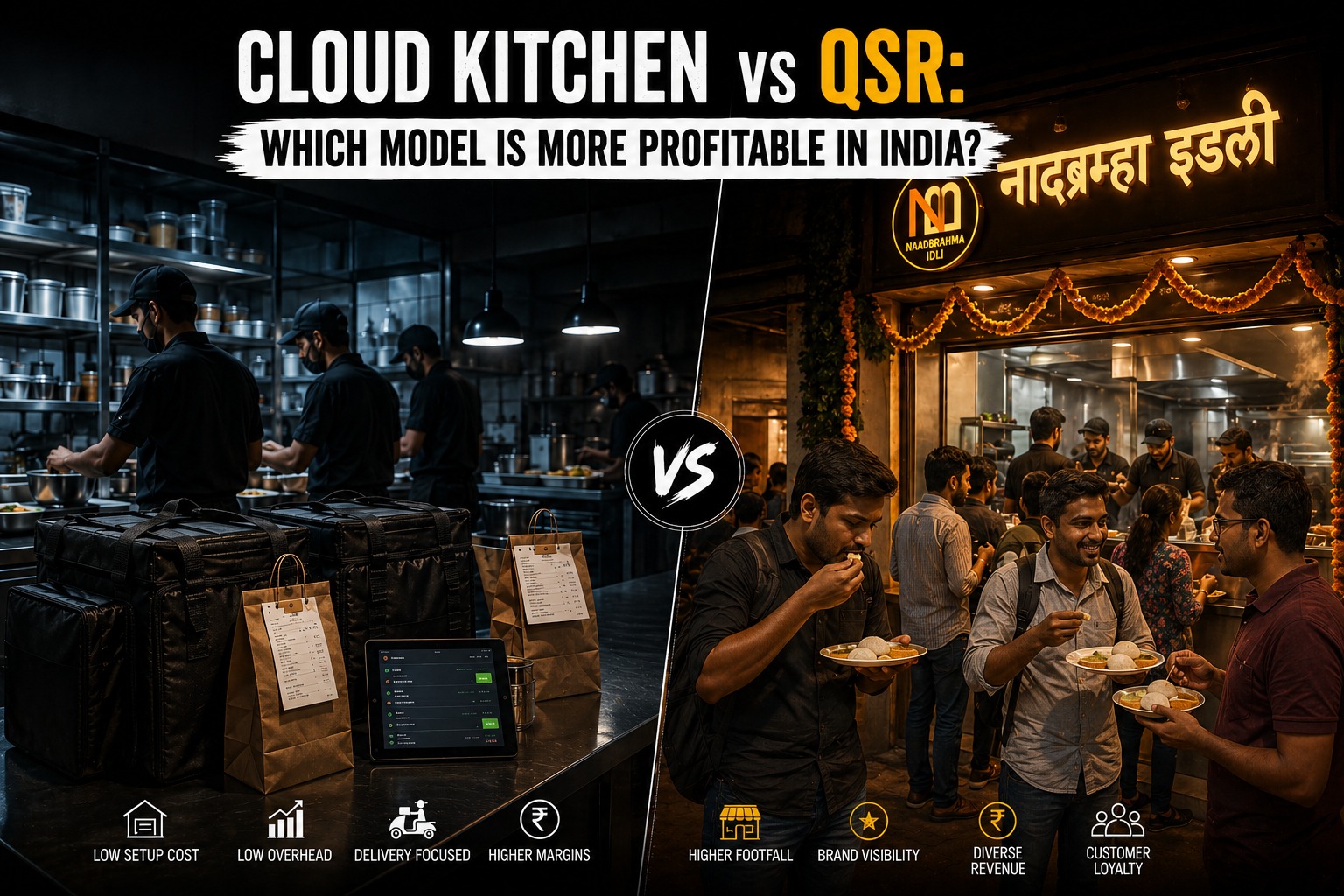
Introduction: The Big Question Every Food Entrepreneur Is Asking
India's food service industry is one of the fastest-growing sectors in the country - projected to surpass ₹7.76 lakh crore by 2025. With food delivery apps at an all-time high and franchise opportunities expanding into every corner of the country, entrepreneurs are asking one important question:
Should I invest in a Cloud Kitchen or a QSR (Quick Service Restaurant)?
Both models have grown rapidly in India. Both have success stories. But when you look at the real numbers, long-term sustainability, and profitability - especially in the Indian market - one model clearly wins.
In this blog, we break down Cloud Kitchen vs QSR in India, compare profitability, and help you make the smartest investment decision for your food business.
What Is a Cloud Kitchen? (And How Does It Work in India?)
A cloud kitchen - also known as a ghost kitchen or dark kitchen - is a delivery-only food business with no physical dine-in space, no storefront, and no walk-in customers. All orders are placed through third-party platforms like Swiggy and Zomato, and food is delivered directly to the customer's doorstep.
Cloud kitchens became popular in India during and after the COVID-19 pandemic, largely due to the explosive growth of food delivery apps. They were marketed as a low-cost way to enter the food business.
Key characteristics of a Cloud Kitchen:
- No dine-in facility
- 100% dependent on Swiggy, Zomato, or similar platforms
- Lower initial setup cost (₹5–10 lakhs)
- No physical brand presence
- High platform commission fees (30–40% per order)
What Is a QSR? (Quick Service Restaurant Model Explained)
A Quick Service Restaurant (QSR) is a fast-food outlet that serves customers quickly at an affordable price. QSRs have a physical location where customers can walk in, dine in, or carry out their orders - with food delivery as an added revenue stream.
In India, homegrown QSR brands like Naadbramha Idli are proving that regional fast food with strong cultural identity can be extraordinarily profitable.
Key characteristics of a QSR:
- Physical outlet with walk-in customers
- Multiple revenue streams: dine-in, takeaway, delivery
- Strong brand visibility and trust
- Loyal local customer base
- Backed by a proven franchise system
5 Reasons Why the QSR Model Is More Profitable in India
1. You Own Your Customer - Not the Platform
In a cloud kitchen model, customers order through Swiggy or Zomato. Their loyalty is to the platform, not your brand. The moment a competitor offers a discount, your customer is gone.
In a QSR, customers walk into your outlet, eat your food, and form a relationship with your brand. That loyalty is yours to keep - and it compounds over time into repeat business, word-of-mouth referrals, and a growing local fanbase.
2. No Platform Commission Bleeding Your Profits
This is the number that cloud kitchen investors often overlook until it is too late. Every order placed through Swiggy or Zomato costs you 30 - 40% in platform commission. On a ₹200 order, you are handing over ₹60 - 80 before accounting for ingredients, packaging, or staff costs.
A QSR keeps 100% of every walk-in or takeaway order. Even when a QSR offers delivery, the dependence on third-party platforms is far lower - and can be managed strategically. This single factor can be the difference between a 12% net margin and a 25%+ net margin.
Leave a comment
Your email address will not be published. Required fields are marked *