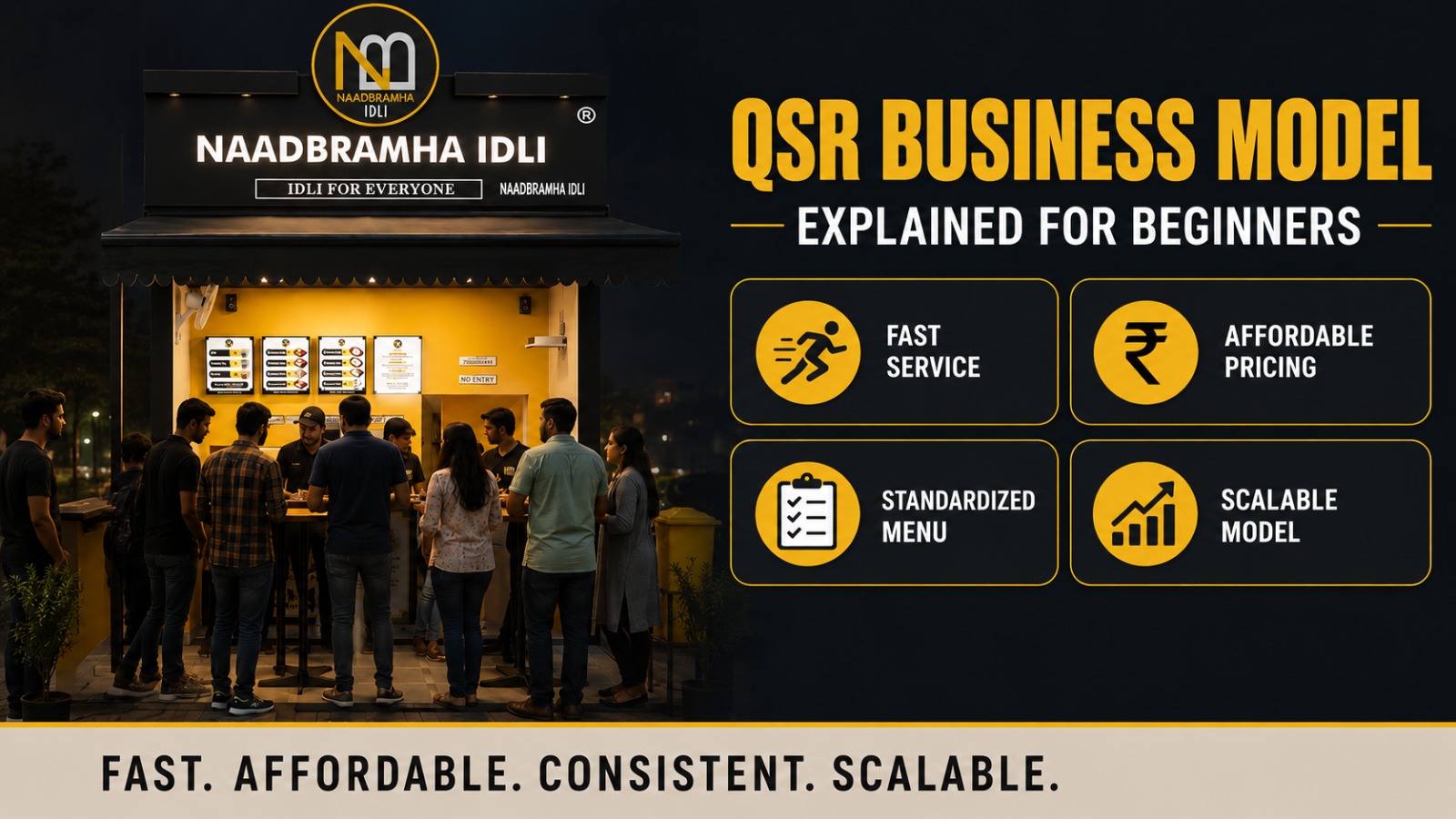
If you have ever grabbed a quick meal in under five minutes, you have already experienced a QSR. From idlis and burgers to sandwiches and pizzas, Quick Service Restaurants serve food fast, affordably, and consistently - every single time.
What is a QSR?
QSR stands for Quick Service Restaurant - a food business built on four core promises: fast service, affordable pricing, standardized quality, and high customer volume.
Popular global examples include McDonald's, Domino's, and Subway. In India, brands like Naadbramha Idli, Haldiram's, and Jumboking have mastered the model.
Quick food. Consistent taste. Affordable pricing.
How the QSR Business Model Works
Standardization - Every outlet uses the same recipes and processes, delivering the same taste and experience across all locations.
Speed - QSR kitchens are built for efficiency, serving customers within 3 to 5 minutes. Faster service means more customers and higher daily sales.
Affordability - Bulk ingredient purchasing and simplified menus keep costs low and prices accessible for mass-market customers.
Scalability - Standardized operations allow rapid expansion through company-owned stores, franchise outlets, and cloud kitchens.
How QSRs Make Money
Walk-In Sales - Direct counter sales remain the largest and most consistent revenue source.
Online Delivery - Swiggy and Zomato have become major growth drivers, opening a new customer base beyond physical footfall.
Franchise Fees - Brands earn through one-time franchise fees, monthly royalties, and marketing charges from franchise partners.
Combos and Upselling - Meal combos and add-ons increase the average order value and overall profitability per customer.
QSR Cost Structure
A typical QSR spends 25 to 35 percent of revenue on food costs, 20 to 30 percent on labour, 8 to 15 percent on rent depending on location, and another 5 to 10 percent on marketing and delivery commissions.
A well-managed QSR targets a net profit margin of 10 to 20 percent.
Company-Owned vs Franchise Model
Company-Owned outlets offer better quality control and brand consistency but require high investment and expand slowly.
Franchise Model allows faster growth at lower risk by letting independent operators run outlets using the brand's systems - though maintaining quality standards becomes a challenge at scale.
Most successful QSR chains use a smart mix of both.
QSR vs Traditional Restaurants
A QSR serves customers in under 5 minutes at a low average bill and is highly scalable. Casual dining takes 15 to 30 minutes with a medium bill and moderate scalability. Fine dining takes 45 to 90 minutes, commands a high bill, but is difficult to scale. This makes QSR the most efficient model for rapid growth and mass-market reach.
QSR in India - A Fast Growing Opportunity
India's QSR market is booming, driven by urban lifestyles, a young population, food delivery apps, and rising disposable incomes. Regional food QSR brands are gaining strong traction as customers seek fast, hygienic, and affordable meals close to home.
The Indian QSR market is projected to cross ₹1 lakh crore by 2030.
Final Thoughts
The QSR model combines speed, consistency, scalability, and operational efficiency - making it one of the most successful restaurant formats in the world. For anyone exploring the food business, understanding QSR is the perfect starting point.
India's QSR industry is growing fast. The opportunity has never been bigger.
Leave a comment
Your email address will not be published. Required fields are marked *